

Magnifying Makeup Mirrors Vs Led Makeup Mirrors
If you’ve ever spent twenty minutes perfecting a winged eyeliner in your bedroom, only to step into the hallway and realize it’s lopsided, you know exactly why this decision matters. When we are setting up a teen’s vanity—especially in those tight bedroom corners or shared bathroom spaces—choosing between a specialized magnifying mirror and a versatile LED mirror is the difference between a seamless morning routine and a frustrating battle with lighting. For parents on a budget and teens wanting that Pinterest-perfect setup, picking the right tool means avoiding the "buy it once, buy it right" trap.
In this guide, I’m breaking down the real-world differences between high-magnification tools and LED-focused mirrors. We aren't just looking at the flashy numbers on the box; we are looking at how these mirrors actually perform during a rushed school morning or a weekend self-care session. We will dive into the technical side—like color temperatures and the practical realities of zoom levels—to help you decide which setup will actually fit your space and your lifestyle without wasting money on gadgets that look great in photos but fail in person.
Affiliate disclosure: if you buy through these links, we may earn a commission at no extra cost to you.
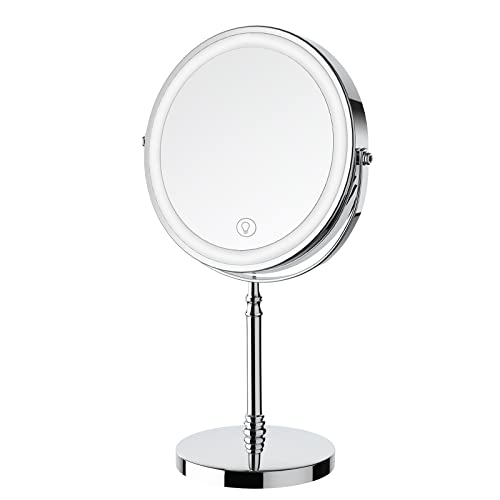
Table of Contents
- Models in this comparison
- Quick Verdict
- About Magnifying Makeup Mirrors
- About Led Makeup Mirrors
- Head-to-Head: Magnification Power vs. Daily Versatility
- Head-to-Head: Lighting Quality and Color Accuracy
- Who Should Choose Magnifying Makeup Mirrors?
- Who Should Choose LED Makeup Mirrors?
- Our Verdict
- Frequently Asked Questions
- Sources & References
Models in this comparison
Affiliate disclosure: if you buy through these links, we may earn a commission at no extra cost to you.


Quick Verdict
Choose Magnifying Makeup Mirrors if...
- Your teen needs surgical-level precision for tasks like eyebrow plucking or eyeliner.
- You are working with very limited desk space and need a compact, specialized tool.
- The primary goal is "detail work" rather than full-face makeup application.
Choose LED Makeup Mirrors if...
- You want a versatile, all-in-one solution for full-face morning routines.
- You need to simulate different environments (like school lighting vs. evening light) using multiple color temperatures.
- You want a balance of 1x viewing for general use and higher magnification for close-up grooming.
| Factor | Magnifying Makeup Mirrors | LED Makeup Mirrors |
|---|---|---|
| Primary Purpose | Precision tasks (tweezing, eyeliner, pore inspection) | Overall face viewing and color-accurate makeup application |
| Optimal Viewing Distance | Requires being very close (3 to 8 inches depending on power) | Designed for natural sitting or standing distance |
| Best For... | The "detail work" phase of a beauty routine | The "full face" application and morning routine |
| Key Advantage | Extreme detail clarity for surgical-level precision | Simulates different environments (warm, natural, cool) | lay-out-instruction
| Main Drawback | Can cause dizziness or a blurry image if you lean back | Lacks the extreme close-up zoom needed for tiny details |
| Space-Saving Tip | Choose a compact, swivel-based model to tuck into corners. | Look for slim-profile LED units that fit on narrow vanities. |
About Magnifying Makeup Mirrors
When you're looking at those high-magnification mirrors on Amazon, it is easy to get caught up in the big numbers like 20X or 30X. As a mom who has seen many "too-big-for-the-desk" purchases, I want to clarify what those numbers actually mean for a teen's morning routine. Magnification is all about how close you have to be to the glass. For example, a 5x magnification mirror typically requires a viewing distance of sometime between 6 to 8 inches. If you step back even a little, the image can shift. A 10x magnification mirror requires an even closer distance of approximately 3 to 4 inches to maintain a sharp image.
For precise tasks like eyebrow plucking or eyeliner, experts suggest that a 10x to 15x magnification level is the practical sweet spot. While a 30X mirror might look impressive in a product photo, it often requires you to be so close to the glass that it becomes difficult to move naturally. This is why I always recommend a dual-sided mirror. Having a 1x side for general viewing (like applying blush or checking your overall hair) combined with a higher magnification side for detail work offers the best versatility for a small vanity setup.
Space-saving tip: If you are working with a tiny desk or a shared bathroom counter, look for a swivel-base magnifying mirror. It allows you to tuck the mirror away when not in use, rather than taking up permanent footprint on a crowded surface.
About Led Makeup Mirrors
If the goal is to prevent that dreaded "makeup mismatch" where your foundation looks perfect in the bedroom but orange in the school hallway, LED technology is your best friend. High-quality LED mirrors often feature three distinct color modes: warm (300{K}), natural (4500K), and cool (6000K). These modes allow a teen to simulate different environments, from a dim bedroom to a bright classroom. To ensure your skin tones look accurate, look for mirrors with a high Color Rendering Index (CRI) of 90 or above. For instance, the VESAUR 8.5" mirror features 90 LEDs and a CRI above 97, which helps provide a professional-grade, true-to-life reflection.
When shopping for LED mirrors, don't just look at the brightness; look at the light distribution. You want flicker-free, evenly distributed LED arrays to prevent shadows that can lead to uneven foundation application. For those managing a budget, remember that "dimmable" or "stepless" brightness is a huge value-add. It allows you to adjust the light to match the ambient light in the room, preventing that washed-out look. Whether you choose a rechargeable model for cordless freedom or a corded version for constant power, the quality of the light is what determines if the mirror is a tool or just a piece of decor.
Space-saving tip: For shared bathrooms or cramped vanities, choose a rechargeable LED mirror. Eliminating the need for a bulky power cord keeps your workspace clear of "cable clutter" and allows you to move the light exactly where you need it.
Head-to-Head: Magnification Power vs. Daily Versatility
When you're looking at those high-number magnification specs on Amazon, it is easy to get caught up in the "bigger is better" trap. A 10x magnification mirror is incredible for precision tasks like eyebrow plucking or eyeliner, but it requires you to be very close—typically only 3 to 4 inches away—to maintain a sharp image. If you lean back even slightly, the image can become distorted or blurry. For many teens, a 10x mirror might look great in a Pinterest photo, but in a real-world morning routine, it can feel limiting if you can't step back to check your overall look.
On the other hand, LED-focused mirrors often prioritize a 1x viewing side alongside a moderate magnification level. A 5x magnification mirror is often the "sweet spot" for many, as it allows for a comfortable viewing distance of 6 to ches. This balance is perfect for tasks like applying blush or checking foundation blending. For the best of both worlds, I always recommend a dual-sided mirror. Having a 1x side for general grooming and a higher magnification side for detail work ensures you aren't constantly fighting with a distorted reflection during your morning rush.
Space-saving tip: If you are working with a tiny desk or a shared bathroom vanity, choose a dual-sided swivel mirror. It gives you two different tools in the footprint of one, saving precious surface space.
Head-to-Head: Lighting Quality and Color Accuracy
The biggest risk with a cheap mirror is "makeup mismatch"—stepping out of the house only to realize your foundation looks orange in the sunlight. This is where LED technology becomes the deciding factor. High-quality LED mirrors offer different color temperatures to simulate various environments: warm (3000K) for evening vibes, natural (4500K) for daylight, and cool (6000K) for bright office lighting. To get the most accurate skin tone representation, look for a high Color Rendering Index (CRI) of 90 or above. For example, the VESAUR 8.5" mirror features 90 LEDs and a CRI above 97, which helps ensure your makeup looks exactly as intended.
While a magnifying mirror focuses on the "zoom," the LED component focuses on the "truth" of your reflection. If you buy a mirror with great magnification but poor lighting, you might get a clear view of your pores but a completely inaccurate view of your skin tone. For a teen bedroom setup, I suggest prioritizing mirrors that offer multiple color modes and stepless dimming. This allows you to adjust the brightness to match the ambient light in the bedroom, preventing that washed-out look that leads to over-applying product.
Space-saving tip: Look for rechargeable, cordless LED mirrors. They eliminate "cord clutter" on your vanity, making a small desk look much cleaner and more organized.
Who Should Choose Magnifying Makeup Mirrors?
If your teen is someone who spends a lot of time on precision tasks—think perfectly winged eyeliner, shaping brows, or dealing with much-needed skincare extractions—a high-magnification mirror is the winner. These mirrors are designed for the "detail work" phase of a beauty routine. However, parents and teens need to be aware of the physical constraints: a 5x magnification mirror typically requires a viewing distance of 6 to 8 inches, while a 10x mirror requires you to be much closer, roughly 3 to 4 inches from the glass, to get a sharp image.
Because higher magnification levels can cause a distorted or inverted image if you lean back too far, these are best suited for someone with a dedicated, stable spot in their bedroom or bathroom where they can sit or stand at a fixed distance. If you are looking at models with 20x or 30x zoom, remember that these are specialized tools for surgical-level detail, not for checking a full face of foundation. They are the perfect "niche" addition to a vanity setup rather than a primary mirror.
Space-saving tip: For small desks, look for a magnifying mirror with a heavy, stable base or a clamp-on design to save precious surface area for makeup organizers.
Who Should Choose LED Makeup Mirrors?
If you want a "one-and-done" solution that handles everything from morning hair brushing to full-face glam, an LED-focused mirror is the better investment. These mirrors are built for versatility. Most quality LED models feature three color modes: warm (3000K) for a cozy evening look, natural (4500K) for daytime simulation, and cool (6000K) for bright, office-style lighting. This variety is essential to prevent the dreaded "makeup mismatch" when stepping out of a bedroom into natural sunlight.
LED mirrors are the ideal choice for the student who needs to simulate different environments to ensure their foundation shade is perfect. For the best results, look for a high Color Rendering Index (CRI) of 90+ to ensure skin tones are rendered accurately. Because many LED mirrors are dual-sided, they offer the best of both worlds: a 1x side for general viewing and a magnified side for those moments when precision is needed. This makes them the most practical choice for shared bathrooms or small bedroom vanities where you only have room for one device.
Space-saving tip: Choose a dual-sided LED mirror to eliminate the need for two separate devices, keeping your vanity clutter-free and budget-friendly.
Our Verdict
If you are looking for a single, definitive answer to "which should I buy," the winner is the LED Makeup Mirror with dual-sided magnification. For a teen bedroom or a shared bathroom, versatility is king. You don't just need to see a single pore; you need to see your whole face to make sure your foundation is blended before you head out to school. A mirror that offers a 1x view for general grooming alongside a high-magnification side (like 10x) provides the best of both worlds without taking up extra desk space.
However, there is a nuance to the "magnification" trap. If you are shopping specifically for precision tasks—like eyebrow plucking or perfecting eyeliner—the Magnifying Makeup Mirror becomes the priority. Just remember: higher magnification requires getting much closer. According to Thewearify, a 5x mirror requires a distance of about 6 to 8 inches, while a 10x mirror demands a much closer distance of 3 to 4 inches. If you buy a high-magnification mirror thinking you can sit back in your vanity chair and use it, you'll be disappointed by a blurry or distorted image.
The Bottom Line:
- Buy an LED-focused dual-sided mirror if: You want an all-in-one solution for your morning routine. Look for models with multiple color temperatures (3000K, 4500K, 6000K) and a high CRI (90+) to ensure your makeup looks right in any lighting.
- Buy a specialized Magnifying Mirror if: You already have a great vanity setup and just need a dedicated tool for "surgical-level" detail work.
For most families, I recommend the dual-sided LED models. They offer the most value for the footprint they take up on a crowded desk, and they prevent that common mistake of buying a massive zoom lens that ends up being too impractical for daily use.
Space-Saving Tip: When choosing a mirror for a small bedroom vanity, prioritize rechargeable, cordless models. Eliminating the need for a power cord keeps your desk surface clear for your acrylic organizers and beauty tools, preventing "cord clutter" in tight quarters.
Frequently Asked Questions
How close do I need to stand to use a magnifying mirror?
It depends entirely on the magnification level! According to Thewearify, a 5x magnification mirror typically requires a viewing distance of is 6 to 8 inches. If you are using a much stronger 10x mirror, you will need to be much closer—approximately 3 to 4 inches—for a sharp, clear image.
What is the best magnification for eyeliner and eyebrows?
While it is tempting to go for the highest number on the box, higher magnification can sometimes lead to a distorted or inverted image if you move slightly. For precise tasks like eyeliner or eyebrow plucking, a 10x to 15x magnification is considered the practical sweet spot for most people.
Why do I need different light colors (Warm vs. Cool)?
Using different color temperatures allows you to simulate different environments. For example, you might use warm light (3000K) to mimic indoor lighting or cool light (6000K) to mimic an office or overcast daylight. This helps prevent the common mistake of applying makeup that looks perfect in the bedroom but looks completely different once you step outside.
What is CRI and why does it matter for my makeup?
CRI stands for Color Rendering Index. It measures how accurately a light source reveals the true colors of objects. When shopping for a vanity mirror, look for a high CRI (90 or above) to ensure your foundation shades and blush colors look accurate and your skin tones are rendered realistically.
Is a dual-sided mirror better than a single-sided one?
For most teen bedrooms and shared bathrooms, a dual-sided mirror is the best value. Having a 1x side for general grooming (like hair brushing or checking your whole face) combined with a high-magnification side for detail work gives you the most versatility without needing multiple bulky products taking up desk space.


